Lics: Navigation using learned-imitation on cluttered space

KAIST, Laboratory for Information and Control Systems
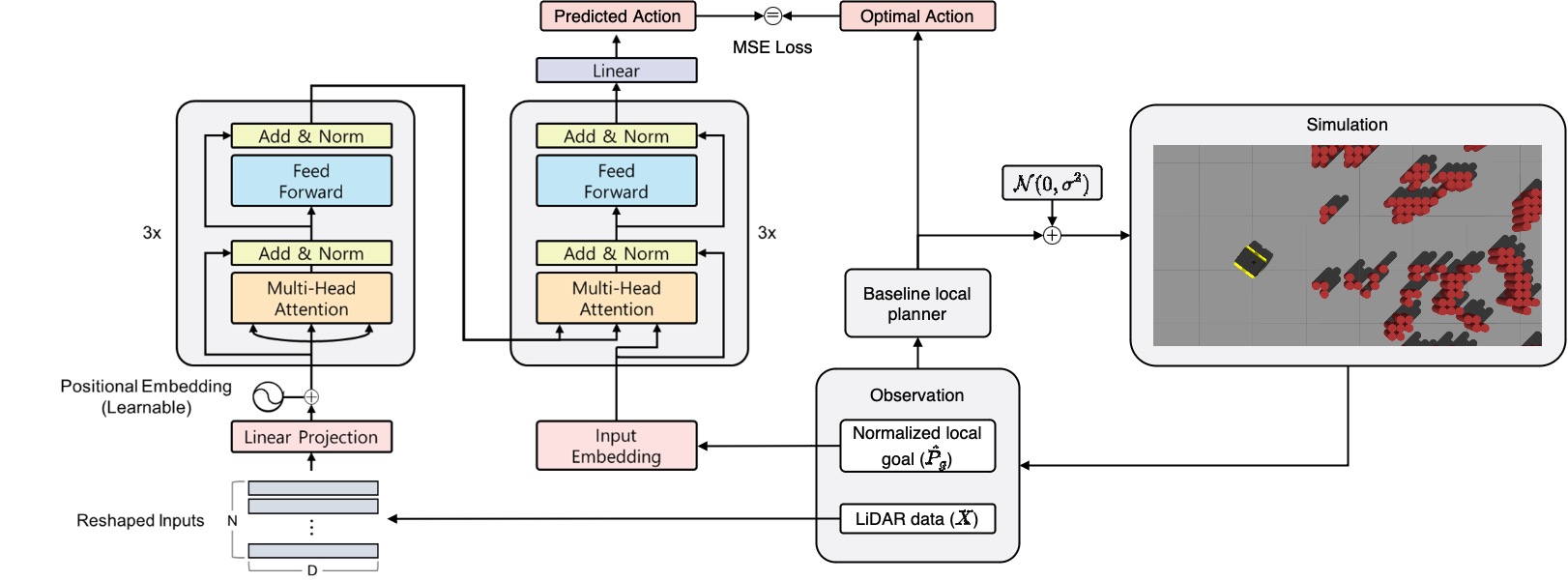
LiCS Training Pipeline Architecture

Figure 1: Training pipeline diagram of the Learned-imitation on Cluttered Space (LiCS) model.

Abstract

In this letter, we propose a robust and fast navigation system in a narrow indoor environment for UGV (Unmanned Ground Vehicle) using 2D LiDAR and odometry. We used behavior cloning with Transformer neural network to learn the optimization-based baseline algorithm. We inject Gaussian noise during expert demonstration to increase the robustness of learned policy. We evaluate the performance of LiCS using both simulation and hardware experiments. It outperforms all other baselines in terms of navigation performance and can maintain its robust performance even on highly cluttered environments. During the hardware experiments, LiCS can maintain safe navigation at maximum speed of 1.5 m/s.
Video Demo

Demonstration of LiCS navigation system in cluttered indoor environments

Method Overview

Behavior Cloning with Transformer

LiCS uses behavior cloning with Transformer neural network to learn from optimization-based expert demonstrations:

  • Sensor Input: 2D LiDAR and odometry data
  • Expert Policy: Optimization-based baseline algorithm
  • Neural Architecture: Transformer with attention mechanism
  • Output: Direct velocity commands (v, ω)

Robustness Enhancement

Key techniques for improving robustness and generalization:

  • Noise Injection: Gaussian noise during expert demonstrations
  • Cluttered Environments: Training in narrow indoor spaces
  • Safe and Fast Navigation: Safe navigation at up to 1.5 m/s
  • Real-time Control: 20 Hz control frequency

Comparative Results

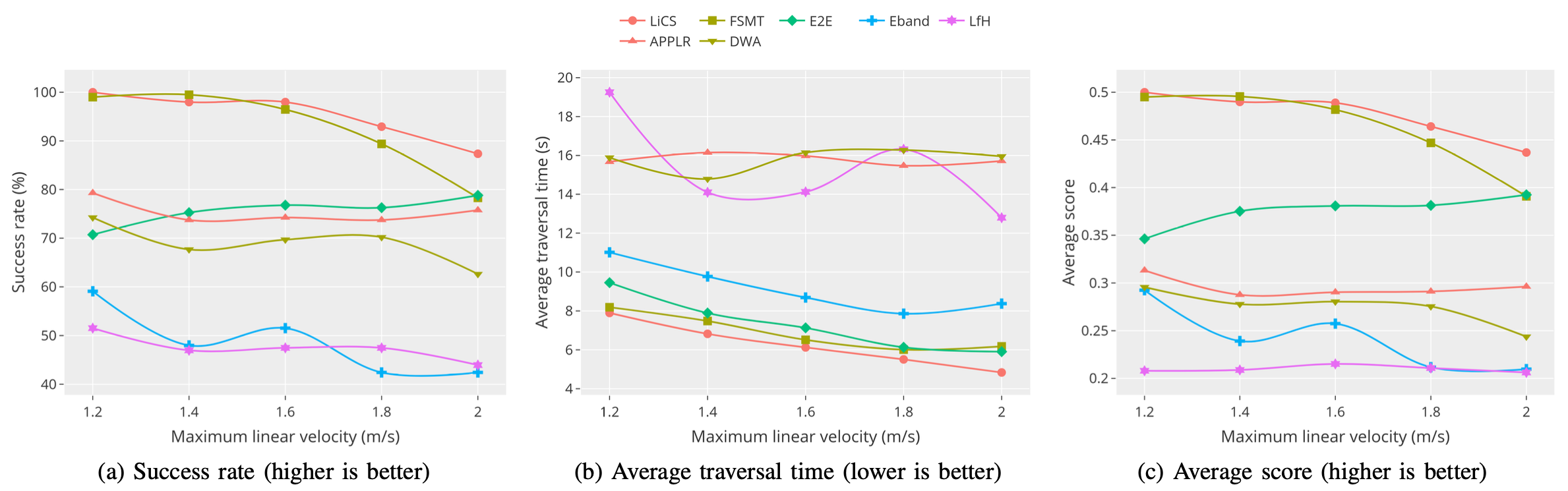
LiCS Comparative Results

Figure 2: Comparative result with baseline algorithms showing LiCS performance across different metrics.

Quantitative Results

Performance Results on Benchmark Worlds

Algorithm Success (%) ↑ Avg. Time (s) ↓ Avg. Score ↑
1.21.41.61.82.0 1.21.41.61.82.0 1.21.41.61.82.0
DWA 74.2467.6869.7070.2062.63 15.8914.7916.1516.2815.96 0.300.280.280.280.24
APPLR 79.2973.7474.2473.7475.76 15.6816.1515.9815.4815.72 0.310.290.290.290.30
EBand 59.0947.9851.5242.4242.42 11.019.778.697.868.38 0.290.240.260.210.21
E2E 70.7175.2576.7776.2678.79 9.457.897.136.135.91 0.350.380.380.380.39
LfH 51.5246.9747.4747.4743.94 19.2514.1014.1216.3212.79 0.210.210.220.210.21
FSMT 98.9999.4996.4689.3978.28 8.197.486.516.016.18 0.4950.500.480.450.39
LiCS (Ours) 100.0097.9897.9892.9387.37 7.906.826.125.514.84 0.5000.490.490.460.44

Table I: Performance results on benchmark worlds with static global point, consisting of waypoints provided by world dataset.
Each experiment on each world was performed in three trials. Numbers in header (1.2-2.0) represent different speed settings.

🥇 Competition Success

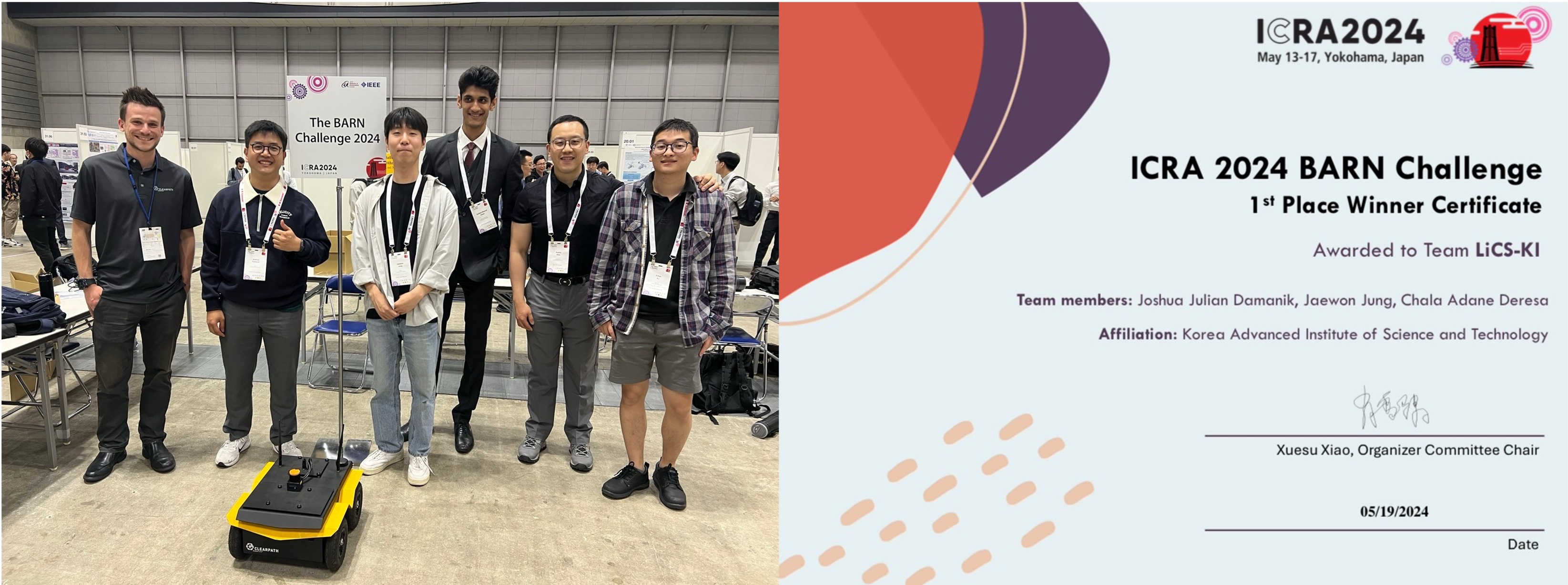
BARN Challenge Winner

BARN Challenge Winner - ICRA 2024

🥇 First Place in both Simulation and Hardware categories

LiCS demonstrated superior performance in the BARN (Benchmark Autonomous Robot Navigation) Challenge, showcasing robust navigation capabilities in cluttered environments.

📄 Published

IEEE Robotics and Automation Letters • 2024

This work has been published in IEEE Robotics and Automation Letters and is available online.

Citation

@article{damanik2024lics,
  author = {Damanik, Joshua Julian and Jung, Jae-Won and Deresa, Chala Adane and Choi, Han-Lim},
  title = {Lics: Navigation using learned-imitation on cluttered space},
  journal = {IEEE Robotics and Automation Letters},
  year = {2024},
  doi = {10.1109/LRA.2024.3498380}
}